Bacopa Monnieri: Benefits, Dosage and Side Effects
Few herbs have earned their place in modern brain science the way Bacopa Monnieri has. Used in Ayurvedic medicine for centuries under the name brahmi, it is now one of the most-studied natural nootropics, with randomized human trials behind its reputation for memory support. If you are considering it — or you already take a formula that contains it — the practical questions matter most: what are the real benefits, how much should you take, how long until it works, and is it safe? This guide answers each one in plain language, backed by the clinical research.
Key Takeaways
- Benefits: strongest evidence for memory and recall, with added support for calm, focus and antioxidant protection.
- Dosage: 300–450 mg/day of a standardized extract (24–55% bacosides), taken with a meal for absorption.
- Timeline: works cumulatively — most benefits appear after about 8–12 weeks of daily use.
- Safety: high therapeutic index and well tolerated; side effects are usually mild and digestive.
What Is Bacopa Monnieri?
Bacopa Monnieri is a small creeping herb that grows in wetlands across India, Southeast Asia and Australia. In Ayurveda it has long been classed as a medhya rasayana — a rejuvenator for the mind — and used to support memory, learning and a sense of calm. Its activity comes mainly from a group of compounds called bacosides, which appear to support neurotransmitter signaling, protect neurons from oxidative stress and encourage the brain's adaptability. We cover that biology in depth in our companion article on how Bacopa Monnieri works; here we focus on the practical side.
Bacopa Monnieri Benefits
Bacopa is unusual among herbal nootropics because it has been tested in numerous randomized, placebo-controlled human trials, not just lab studies. A systematic review of these trials concluded that Bacopa has the potential to improve cognition, particularly memory [2]. Here is what the research most supports.
Memory and Recall
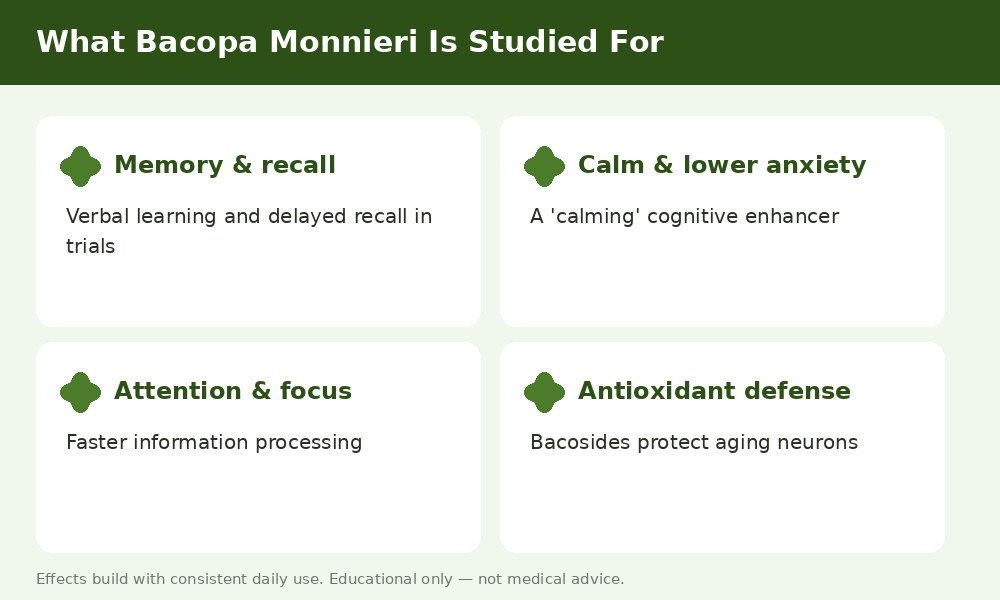
This is Bacopa's headline benefit. Trials repeatedly show improvements in verbal learning, memory acquisition and delayed recall — the ability to take in new information and retrieve it later. In a 12-week, double-blind, placebo-controlled trial in adults 65 and older, a standardized Bacopa extract improved measures of word recall and attention compared with placebo [1]. A separate randomized trial in older adults also reported better memory performance after consistent use [3].
Calm and Lower Anxiety
Unlike stimulant nootropics, Bacopa is often described as a "calming cognitive enhancer." Several trials noted reductions in anxiety alongside the cognitive gains [1]. For adults who find that stress and a racing mind make forgetfulness worse, this dual action is part of the appeal.
Attention and Mental Processing
Beyond raw memory, studies have measured faster information processing and steadier attention with continued use. Because memory and focus depend on each other, supporting one often helps the other.
Antioxidant and Neuroprotective Support
Bacosides act as antioxidants in brain tissue, helping neutralize the free radicals linked to cognitive aging. This protective role is one reason Bacopa is studied specifically in older adults rather than only in young students.
Bacopa Monnieri Dosage: How Much Should You Take?
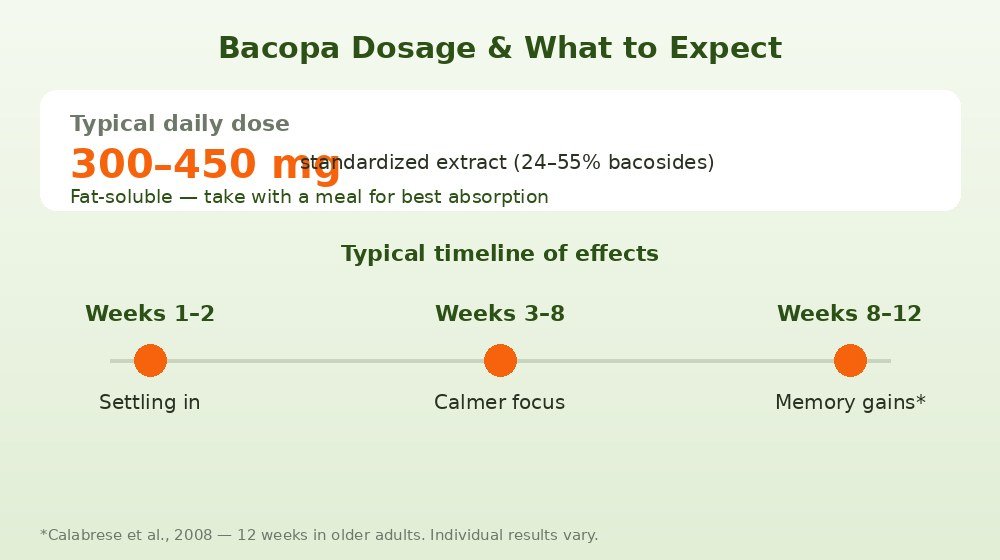
The dose used in most successful human trials is 300 to 450 mg per day of a standardized extract. The number that matters is not just the milligrams of herb but the bacoside content — quality extracts are standardized to roughly 24% to 55% bacosides. Reputable branded extracts you may see on labels include Bacognize, Synapsa, BacoMind and KeenMind.
| Detail | What Research Suggests |
|---|---|
| Typical daily dose | 300–450 mg standardized extract (some trials up to 600 mg) |
| Standardization | 24–55% bacosides (the active compounds) |
| When to take | With a meal — Bacopa is fat-soluble and absorbs better with food |
| Higher doses? | Not necessarily better; consistency beats megadosing |
| Form | Capsules or powder; standardized capsules are easiest to dose |
Expert Insight: Take It With Food
One detail trips people up: Bacopa is fat-soluble. Taken on an empty stomach it absorbs poorly, and it is also more likely to cause mild stomach upset. Traditionally it was consumed with ghee (clarified butter). The modern version is simply to take it with a meal that contains some fat — this improves absorption and is gentler on the stomach.
How Long Does Bacopa Monnieri Take to Work?
This is the question that disappoints people expecting a same-day effect. Bacopa is a cumulative, daily-use herb, not a stimulant. In the clinical trials that found benefits, participants took it consistently for about 12 weeks before cognitive improvements were measured [1][2]. Some people notice a calmer, steadier focus within the first few weeks, but the memory benefits build slowly. The practical takeaway: commit to daily use for at least 8 to 12 weeks before judging whether it works for you.
Bacopa Monnieri Side Effects and Safety
Bacopa has what researchers call a high therapeutic index — it is generally well tolerated, and serious side effects are rare. When side effects do occur, they are usually mild and related to the digestive system.
- Most common: increased stool frequency, nausea, stomach cramps and dry mouth.
- Often avoidable: these effects are frequently reduced or eliminated by taking Bacopa with food.
- Generally short-lived: mild digestive symptoms tend to settle as the body adjusts.
Who Should Be Cautious With Bacopa
Talk to your doctor before taking Bacopa if you are pregnant or breastfeeding (safety data is limited), have a thyroid condition (Bacopa may influence thyroid hormone levels), have a slow heart rate, or take medications that affect acetylcholine or the thyroid. Because Bacopa has cholinergic activity, it can in theory interact with certain prescriptions. Never start or stop any supplement or medication without professional guidance.
Bacopa Monnieri in Memopezil
Bacopa Monnieri is the anchor ingredient in Memopezil, which is no accident — it has the deepest human-trial evidence of any botanical in the cognitive category. In the Memopezil formula it is paired with complementary nootropics that work through different pathways: Ginkgo Biloba for cerebral blood flow, Lion's Mane for nerve growth factor, plus phosphatidylserine, L-theanine and Rhodiola. The goal is to deliver Bacopa at a sensible daily dose alongside ingredients that reinforce rather than duplicate it. You can see the complete formula on the ingredients page or read more on the how it works page. For the deeper biology, our science of Bacopa Monnieri article goes under the hood.
Get Bacopa at a Sensible Daily Dose
Memopezil pairs Bacopa Monnieri with six more science-backed nootropics — caffeine-free and formulated for memory, focus and clarity in adults 60+, so you do not have to stack individual bottles.
ORDER MemoPezil NOWFrequently Asked Questions
What is Bacopa Monnieri good for?
Bacopa is best known as a memory and learning herb. Human trials most consistently show benefits for verbal learning, delayed recall and memory acquisition, and it is also studied for easing anxiety and supporting attention — a "calming cognitive enhancer" [2].
What is the correct dosage of Bacopa Monnieri?
Most studies use 300–450 mg per day of a standardized extract (24–55% bacosides). Bacopa is fat-soluble, so take it with a meal. Higher doses are not necessarily better — consistency matters more.
How long does Bacopa Monnieri take to work?
It works cumulatively. Most trials measured benefits after about 12 weeks of daily use [1]. Some notice calmer focus earlier, but commit to at least 8–12 weeks before judging results.
What are the side effects of Bacopa Monnieri?
It has a high therapeutic index and is well tolerated. The most common side effects are mild and digestive — increased stool frequency, nausea or stomach cramps — and are often reduced by taking it with food.
References and Sources:
- [1] Calabrese, C., et al. (2008). Effects of a standardized Bacopa monnieri extract on cognitive performance, anxiety, and depression in the elderly: a randomized, double-blind, placebo-controlled trial. Journal of Alternative and Complementary Medicine, 14(6), 707–713. PMID: 18611150.
- [2] Pase, M. P., et al. (2012). The cognitive-enhancing effects of Bacopa monnieri: a systematic review of randomized, controlled human clinical trials. Journal of Alternative and Complementary Medicine, 18(7), 647–652. PMID: 22747190.
- [3] Morgan, A., & Stevens, J. (2010). Does Bacopa monnieri improve memory performance in older persons? A randomized, placebo-controlled, double-blind trial. Journal of Alternative and Complementary Medicine, 16(7), 753–759. PMID: 20590480.
- [4] Kongkeaw, C., et al. (2014). Meta-analysis of randomized controlled trials on cognitive effects of Bacopa monnieri extract. Journal of Ethnopharmacology, 151(1), 528–535. PMID: 24252493.
- [5] Aguiar, S., & Borowski, T. — Bacopa monnieri, StatPearls. NCBI Bookshelf (StatPearls Publishing).