Lion's Mane Mushroom for Memory: The Science of NGF, Neurogenesis and Brain Repair
If you have ever walked into a room and forgotten why, struggled to recall a familiar name, or noticed your focus fading earlier in the day, you are not alone. After age 60, subtle shifts in memory and mental sharpness are extremely common. That is exactly why one unusual-looking mushroom has captured the attention of neuroscientists and supplement formulators alike: Lion's Mane (Hericium erinaceus). Unlike a quick-hit stimulant, Lion's Mane is studied for something far more interesting — its potential to support the brain's own repair and growth machinery. In this article we break down exactly how it works, what the clinical research shows, and why it earns its place in the Memo Pezil formula.
Key Takeaways
- Lion's Mane is one of the few natural ingredients shown to influence Nerve Growth Factor (NGF) — a protein essential for neuron maintenance and repair.
- A double-blind, placebo-controlled trial in adults aged 50–80 reported improved cognitive scores after 16 weeks of consistent intake.
- Its active compounds, hericenones and erinacines, are small enough to be studied for crossing into brain-relevant pathways.
- Benefits are cumulative — most research points to results after 8–16 weeks of daily use, not a single dose.
What Is Lion's Mane Mushroom?
Lion's Mane is an edible medicinal mushroom that grows as a cascade of soft white spines resembling a lion's mane — hence the name. Known in Japan as Yamabushitake and used for centuries in traditional East Asian wellness practices, it has moved from the forest floor to the laboratory because of one rare property: it appears to interact with the chemistry of nerve cells. Where most "brain foods" provide antioxidants or raw nutrients, Lion's Mane is studied for actively encouraging the systems that keep neurons healthy [1].
The Real Mechanism: Nerve Growth Factor (NGF)
To understand why Lion's Mane is different, you first need to understand Nerve Growth Factor. NGF is a protein your body produces to support the survival, maintenance and regeneration of neurons. Think of it as a gardener for your brain — it keeps existing nerve cells nourished and helps repair the connections (dendrites and axons) that carry memories and thoughts. As we age, NGF activity can decline, and so can the brain's ability to maintain those connections [6].
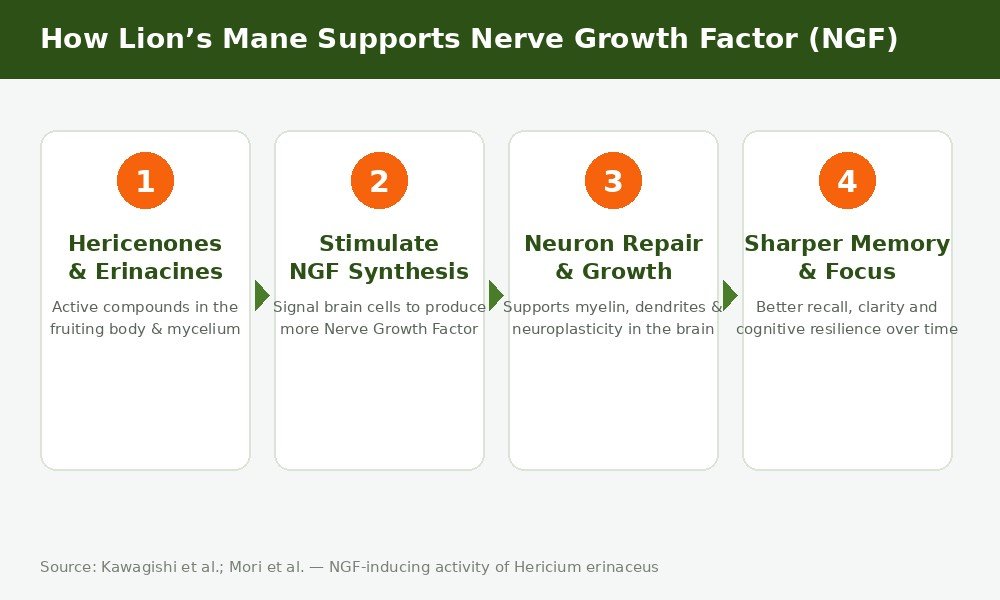
Here is the fascinating part. Lion's Mane contains two unique families of compounds — hericenones (found mainly in the fruiting body) and erinacines (found in the mycelium). In laboratory studies, these compounds were shown to stimulate the synthesis of NGF [2][7]. In other words, rather than supplying NGF directly, Lion's Mane appears to encourage your brain to make more of its own.
Why NGF Matters for Memory After 60
NGF is not a vague wellness buzzword. Research has shown that NGF is essential for plasticity and learning in the hippocampus — the brain's primary memory hub [6]. When neurons are well maintained and their connections stay flexible, the brain can encode new information and retrieve old memories more efficiently. This is precisely the kind of support that becomes more valuable as the brain ages, which is why NGF-influencing ingredients have become such a focus in modern cognitive science.
What the Clinical Research Actually Shows
It is easy to find bold claims online, so let's focus on what controlled human studies have reported. The most cited trial comes from Mori and colleagues (2009), who ran a double-blind, parallel-group, placebo-controlled study on Japanese men and women aged 50 to 80 who had been diagnosed with mild cognitive impairment. Participants took Lion's Mane tablets three times daily for 16 weeks. The group taking Lion's Mane showed significantly higher scores on a recognized cognitive function scale compared to the placebo group — and notably, scores tended to decline again after they stopped taking it, suggesting the effect depended on continued use [1].
Later work has reinforced and expanded on these findings:
| Study | Population | What It Reported |
|---|---|---|
| Mori et al., 2009 | Adults 50–80 with mild cognitive impairment | Improved cognitive scale scores after 16 weeks of daily intake versus placebo [1]. |
| Saitsu et al., 2019 | Healthy adults | Improvement in cognitive function measures with oral Hericium erinaceus intake [3]. |
| Docherty et al., 2023 | Healthy young adults | Suggested faster speed of performance and reduced subjective stress [4]. |
| Li et al., 2020 | Older adults (erinacine A-enriched mycelia) | Pilot double-blind study reporting better cognitive and functional scores [5]. |
Expert Insight: Consistency Beats Intensity
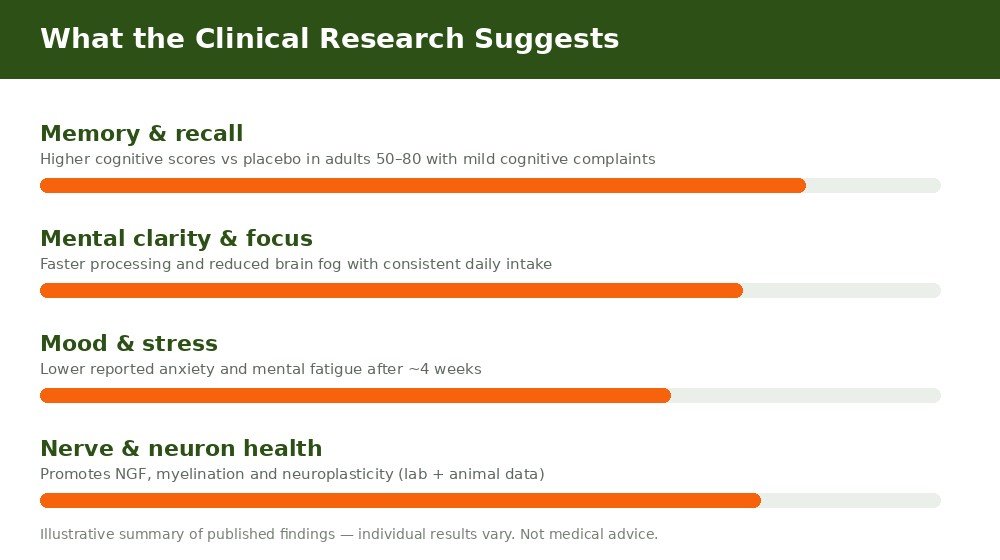
A pattern repeats across nearly every trial: Lion's Mane is a cumulative ingredient. The cognitive benefits in human studies tended to appear after roughly 8 to 16 weeks of daily use — and faded when supplementation stopped. This is very different from caffeine or other stimulants. With Lion's Mane, the most important factor is simply taking it consistently, every day, for long enough.
How Lion's Mane Compares to Other Nootropics
Lion's Mane is rarely used in isolation, and for good reason — it targets a different mechanism than most other brain ingredients. Where Bacopa Monnieri is studied largely for supporting acetylcholine and recall, and Ginkgo Biloba is associated with healthy blood flow to the brain, Lion's Mane is the ingredient most closely linked to nerve maintenance and NGF. This is why thoughtful formulas combine them: each one supports cognition through a complementary pathway rather than overlapping.
Beyond Memory: Mood, Focus and Mental Energy
Memory is the headline, but research has also explored Lion's Mane for related areas of mental wellbeing. Some studies have reported reductions in subjective feelings of anxiety, mental fatigue and low mood with several weeks of intake [4]. Because clear thinking, motivation and emotional balance are deeply connected, supporting one often helps the others — a reason Lion's Mane is valued for overall daily mental clarity, not just recall.
Is Lion's Mane Safe?
Lion's Mane has a long history as an edible food and is generally well tolerated in research settings. In studies, reported side effects have been uncommon and typically mild, such as minor digestive discomfort. That said, as with any supplement, it is sensible to talk with your doctor before starting — especially if you take prescription medication, have a known mushroom allergy, or have a scheduled surgery. Lion's Mane is a complement to a healthy lifestyle, not a replacement for medical care.
Lion's Mane and Memo Pezil
As one of the featured ingredients in Memo Pezil, Lion's Mane contributes a mechanism that few other natural compounds offer: support for the brain's own nerve-maintenance pathways through NGF. Working alongside Bacopa Monnieri, Ginkgo Biloba, L-Theanine and the rest of the formula, it helps round out a comprehensive, multi-pathway approach to memory, focus and long-term cognitive vitality for adults 60 and over. You can see the full breakdown on our ingredients page, or learn more about the science on the how it works page.
Ready to Support Your Memory Naturally?
Discover how Lion's Mane and other carefully selected nootropics in Memo Pezil may help support focus, memory and cognitive wellness — backed by science, made for adults 60+.
ORDER MemoPezil NOWReferences and Sources:
- [1] Mori, K., et al. (2009). Improving effects of the mushroom Yamabushitake (Hericium erinaceus) on mild cognitive impairment: a double-blind placebo-controlled clinical trial. Phytotherapy Research, 23(3), 367–372.
- [2] Kawagishi, H., et al. (1996). Erinacines, stimulators of nerve growth factor (NGF) synthesis, from the mycelia of Hericium erinaceum. Tetrahedron Letters (PubMed).
- [3] Saitsu, Y., et al. (2019). Improvement of cognitive functions by oral intake of Hericium erinaceus. Biomedical Research, 40(4), 125–131.
- [4] Docherty, S., Doughty, F. L., & Smith, E. F. (2023). The Acute and Chronic Effects of Lion's Mane Mushroom Supplementation on Cognitive Function, Stress and Mood in Young Adults. Nutrients, 15(22), 4842.
- [5] Li, I. C., et al. (2020). Prevention of Early Alzheimer's Disease by Erinacine A-Enriched Hericium erinaceus Mycelia: Pilot Double-Blind Placebo-Controlled Study. Frontiers in Aging Neuroscience, 12, 155.
- [6] Conner, J. M., et al. (2009). NGF is essential for hippocampal plasticity and learning. The Journal of Neuroscience, 29(35), 10883–10889.
- [7] Alzheimer's Drug Discovery Foundation — Cognitive Vitality: Lion's Mane evidence review. Source Link.